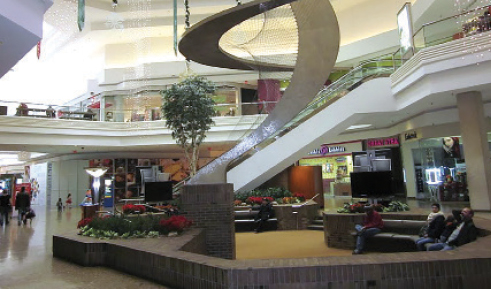
1. Lessons learned and best practices from other mall walking programs.
Existing mall walking programs may help
guide the process of starting a mall walking program. Learn from the experiences of other malls and successful mall walking programs that already exist. Talk to mall walkers, mall managers, and mall program leaders to determine their lessons learned and the best practices that are working in their programs.
You can also learn from the five successful Examples of Mall Walking Programs described on pp. 16–24 of this Guide.
2. Mall management support.
If you are interested in partnering with a mall in your community to start a mall walking program, discuss the potential partnership of your organization with a mall manager. Highlight the potential benefits to both the mall and your organization, and secure mall management buy-in and support. Begin joint collaboration on the development of the mall walking program. Help identify needed resources and in-kind contributions that can be made.
3. Personnel that may be needed.
It may be valuable to identify and hire a program leader (e.g., a trained health or fitness professional or certified exercise leader with excellent interpersonal skills) to plan and monitor your mall walking program’s success. The program leader may be a current mall employee with training in health and fitness or an employee of a sponsoring or supportive partner organization (e.g., hospital or fitness center), or a new hire.
4. Partnerships that may enhance a mall walking program.
Mall walking programs can be informal or formal in organization. Informal programs welcome mall walkers, but do not provide organizational support, promotional activities, or planned community outreach to recruit walkers to the mall. This Guide is for mall managers and others wishing to start a mall walking program with a more formal format. Formal programs can be structured in many ways. For example, a mall walking program may be started by mall management solely as a way of connecting community members—walkers and shoppers—to the mall. Another example is that a partnership may be developed between the mall and one or more community-based organizations, such as a hospital or health and fitness organization. Mall management might want to consider any benefits from locating and securing support from one or more community-based organizations. These benefits might include added promotional opportunities, combining resources, and increased foot traffic into the mall.
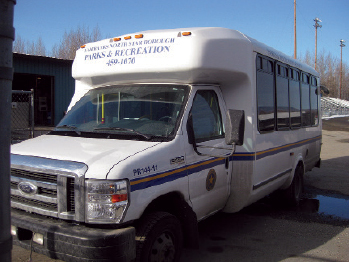 Parks and Recreation van transporting walkers to and from the mall.
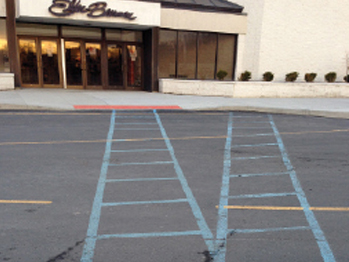 Pedestrian cross walk.
5. Transportation.
During the planning of a mall walking program, consider transportation from home to the mall and back as an important issue that may influence initial and continued participation in the program. Many malls are isolated from the communities they serve by highway and roadway barriers, and access to the malls by walking or biking are not options. Because transportation may be a barrier or facilitator for participating in a mall walking program, some solutions you might consider are
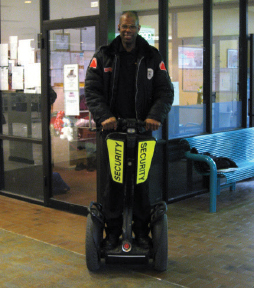 Mall security on a Segway.
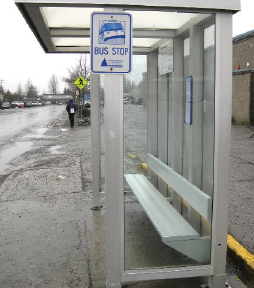 Covered transit stop near mall entrance.
- Providing information to walkers in flyers and posters about the nearest public transit stops to the mall.
- Making safe passage, free of traffic congestion, from transit stops to mall entrances available to all mall attendees, mall walkers, and shoppers.
- Placing transit stops in a safe area close to a mall entrance, and sheltered from the weather, to facilitate accessibility of passengers boarding and exiting a bus or shuttle van.
- Exploring subsidized or reasonably priced community transportation services for walkers who no longer drive.
- Encouraging carpooling or shared rides, as needed and appropriate, among the mall walking program participants.
6. Programmatic characteristics of the mall walking program.
Characteristics of a mall walking program will vary on the basis of the mall location and the decisions the mall manager will make. Some things to consider are as follows:
- Determine when mall entrance doors and bathrooms open to the public.
- Determine hours of operation for the mall walking program.
- Determine when security staff are at the mall, to coincide with mall walking program hours of operation.
- Develop necessary forms. Suggested program forms
- Membership enrollment form
(Appendix A and Appendix B).
- Walking logs (Appendix C).
- Brochures (Appendix D).
- Flyer with route distance (Appendix F).
- Any other materials needed to support record keeping.
- Obtain locked file cabinets to secure materials.
- Determine type and volume of background music in the mall before shops open, and during mall walking hours of operation.
- Identify one or more mall walking routes that are safe and free of trip hazards. Consider the following:
- A well-lit route(s).
- A route(s) where benches or rest areas are available at periodic intervals.
- A route having availability of free water (e.g., an accessible water fountain).
- A route that passes nearby one or more restrooms.
- Determine the distance or length of route(s), and mark routes with signage.
- Develop route maps with distances and give maps to persons interested in mall walking (Appendix F).
- Consider a central meeting place for mall walkers to check-in, do record keeping, and congregate before and after walking.
- Consider providing a place for mall walkers to hang jackets or store belongings securely.
- Use kiosks or bulletin board displays to communicate about the mall walking program, distribute health education materials, and identify and publicize community health and fitness events.
- Consider offering the following as part of the mall walking program:
- Blood pressure screenings.
- Staff-led stretching.
- Guest speakers to give periodic health lectures.
- Health fairs and educational events.
- Health-related newsletters, fliers, and bulletins.
- Events to celebrate birthdays or holidays.
- Identify retail stores that are focused on physical activity (e.g., sell items such as walking shoes, other athletic attire, or equipment), and determine their interest in supporting the mall walking program in some way (e.g., provide pedometers for use by walkers, maintain information on bulletin boards about community events and opportunities to be active, sponsor one or two file cabinets or space for the mall walking program leader and program participants to store their records and exercise logs).
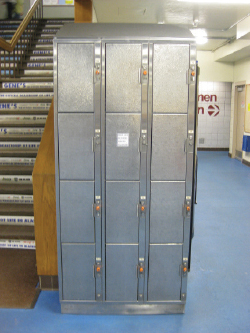 Lockers allow for storing of belongings while walking.
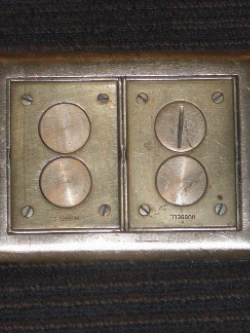 Caution with floor outlets.
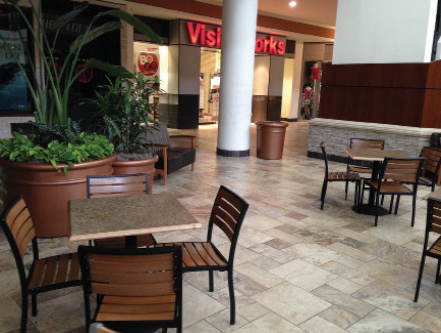 Mall sitting area.
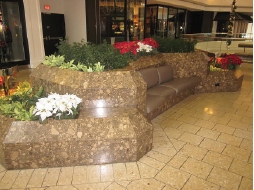 Planters in a mall.
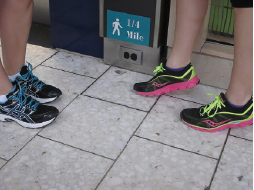 Mile markers help walkers determine distance walked.
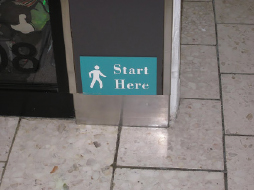 Distance marker for mall walkers.
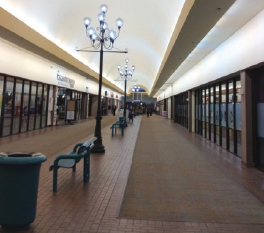 Mall hall way with benches.
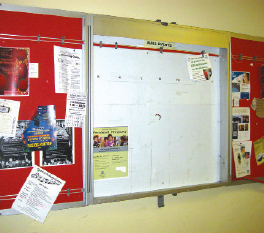 Mall walker’s bulletin board with announcements, educational and health materials, and community information and events.
7. Community diversity and culture.
To the extent possible, mall walking programs should integrate into the community where they are located. An advantage of mall walking programs is that they are highly adaptable and can be tailored to meet the preferences and needs of residents living close to the mall walking program. When tailoring a mall walking program, consider the following:
- The local population, culture, and setting so as to attract the largest number of walkers. Walking programs can serve as outlets for health information beyond the benefits associated with walking. Addressing the health needs of a community can be accomplished, in part, with targeted health education materials, health fairs, publicizing community health-related events, and bringing in guest speakers to address health issues relevant to community members. Using the mall walking program as the point of contact for obtaining and disseminating health information and organizing activities can help build community support for the mall in general, and mall walking program, specifically.
- Designing the mall walking program to accommodate diverse populations, as different cultures may view walking differently (e.g., as an activity for health and fitness, leisure-time activity, or a destination-oriented purposeful activity).
- Outreach to and inclusion of community residents. This can be done by working collaboratively with neighborhood associations and different community groups, including employers, organizations representing persons with disabilities and different racial and ethnic groups, faith-based organizations, and media to identify and explore ways to meet the unique needs of community groups and how to make community members feel welcomed to join a mall walking program.
8. Safety.
Plan for safety, and make sure safety precautions are in place.
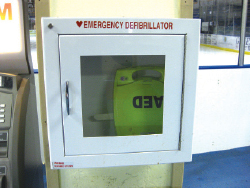 Defibrillator as an example of emergency equipment available in a mall.
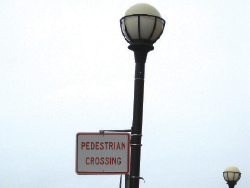 Pedestrian crossing sign.
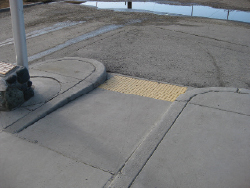 Ramped curb cut with truncated domes.
- Mall walking program leaders and program participants should know where first aid and emergency equipment is located. Mall walkers should have access to the same first aid, emergency equipment, and safety personnel as mall shoppers.
- Identify a dedicated entry way for use by mall walkers that is close to the centralized mall walking program meeting area. Ideally, this area should be safe from traffic congestion, convenient to bus transit stops, and sheltered from inclement weather by a covered entry way for walkers entering and exiting the mall from transportation drop-offs and pick-ups.
- Consider inviting the mall walkers to complete a brief health history form to identify if they have any known chronic disease conditions that may require obtaining physician clearance and approval to be in a mall walking program. One such form is the Physical Activity Readiness Questionnaire (PAR-Q) or a similar questionnaire (Appendix C and http://www.csep.ca/english/View.asp?x=698). Another option is the EASY tool (http://www.easyforyou.info/index.asp).
- Ensure that mall security personnel are present during mall walking program hours of operation.
9. Costs and economic factors.
Costs related to a mall walking program can be related to personnel, materials, marketing, and incentives for the participants. These costs can be covered by the mall or shared by one or more mall walking program partners.
Some costs to consider are
- Program leader salary.
- Mall security personnel, (if security is made available specifically for the mall walking program, rather than as a part of overall mall security).
- Purchase of kiosks or bulletin boards.
- Route signage and route maps.
- Record keeping supplies.
- Record keeping secure file cabinets.
- Educational materials.
- Pedometers or other promotional materials.
- Coat racks.
- Benches, (if malls do not provide them already).
You can also encourage retailers to offer incentives to mall walkers to shop in their stores.
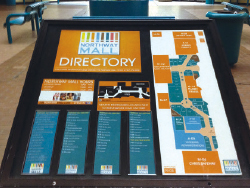 Map showing location of mall stores.
10. How to attract and retain mall walking program participants.
Generate publicity and broadly disseminate information about your mall walking program to recruit mall walking program participants, and provide incentives to promote and sustain program adherence.
Consider a variety of channels to advertise and “get the word out” about the mall walking program. These can include the following:
- Design a brochure (Appendix D) or flyer (Appendix E) to promote the mall walking program. Post the brochure or flier throughout the mall, and distribute to nearby facilities and organizations, especially those that serve older adults (e.g., retirement communities, senior centers, and community centers).
- Develop a website that publicizes the mall walking program. The website can include forms needed for the program, such as application to join the mall walking program, a health history form, liability wavier form, or information about the program, such as route maps and hours of operation.
- Publish a periodic newsletter about the mall walking program and any health-related events that are promoted by the program leader.
- Obtain media coverage (newspaper, television, radio) of the mall walking program. Publicize special health-related events organized with the mall walking program.
- Plan a kickoff event publicizing the start-up of the program:
- Invite a speaker who is a walking role model or wellness champion to talk about the benefits of walking.
- Offer prizes during the kickoff event donated by stores in the mall.
- Invite media to cover the event and to increase exposure and visibility of the mall walking program in the community.
 Three mall walkers.
11. Evaluation.
Evaluation is an important component of successfully maintaining a mall walking program. Evaluation data can be used to evaluate how the program is being implemented and to identify ways to improve it, to evaluate outcomes important to the mall walking program leaders and program participants and partners, and to identify the costs and other economic factors related to the mall walking program (see “Cost and economic factors”). Types of evaluations are as follows:
- Walker satisfaction. Provide a way for walkers to give feedback, suggestions, point out problems and solutions. This could be a suggestion box, that someone checks regularly and responds to, or a short satisfaction survey.
- Business owner satisfaction. Provide a way for business owners, managers, mall personnel to give feedback on any positive or negative impact associated with the mall walking program.
- Impact of walking on health. Partner with public health or university researchers to collect data on health benefits over time. Encourage walkers to monitor their own health improvements by providing them with logs or kiosks where they can enter their weekly mall walking by using a log book (record days/dates walked; laps or distance walked; amount of time walked; number of steps walked [will require use of pedometers or smart phone apps that measure steps], distance or speed walked) (See Appendix F).
- Walking environment and safety. Walk the mall, or ask mall walkers to identify any issues along the walking route.